AQUILEIA
PATRIMONIO DELL'UMANITÀ
lunedì 5 ottobre 2026
New headquarters of the Aquileia Foundation
In Aquileia, Palazzo Brunner-Segré returns to life after restoration
Samantha De Martin - 16/06/2025
A treasure trove of history, archaeology and architecture in the heart of Aquileia has been brought back to life and returned to the community.
Following a conservative restoration project, Palazzo Brunner-Segré, acquired in 1996 by the State Property Office (Ministry of Culture) and transferred to the Aquileia Foundation in 2019, was inaugurated during European Archaeology Days.
The historic building in Via Roma will be the new headquarters and offices of the Fondazione Aquileia. The second floor will house a conference room, while a second phase of the project will involve the enhancement of the outdoor area, which encompasses a portion of the ancient Roman amphitheatre, and the creation of a visitor route connecting the building to Via XXIV Maggio.
“The restoration of Palazzo Brunner-Segré,” comments Roberto Corciulo, president of the Aquileia Foundation, “is particularly significant because it is a valuable historic building that has been returned to the admiration of visitors. The restoration of the historic centre’s architectural heritage, which consists of remarkable examples of spontaneous architecture, and its use to serve our guests is one of the objectives of the Foundation, which in recent years has acquired several private properties in the basilica area that were no longer inhabited. The total cost of the work, amounting to €3,068,000, was financed to the tune of €3 million thanks to the Development and Cohesion Funds of the Ministry of Culture, which, thanks to the prompt interest of the Culture Department of the Friuli Venezia Giulia Region, we were able to divert towards the restoration of Palazzo Brunner-Segré'.
It took two years of work to complete the urban regeneration of the building, located along one of the main medieval roads, the district of Sant'Andrea or dei Calzolai.
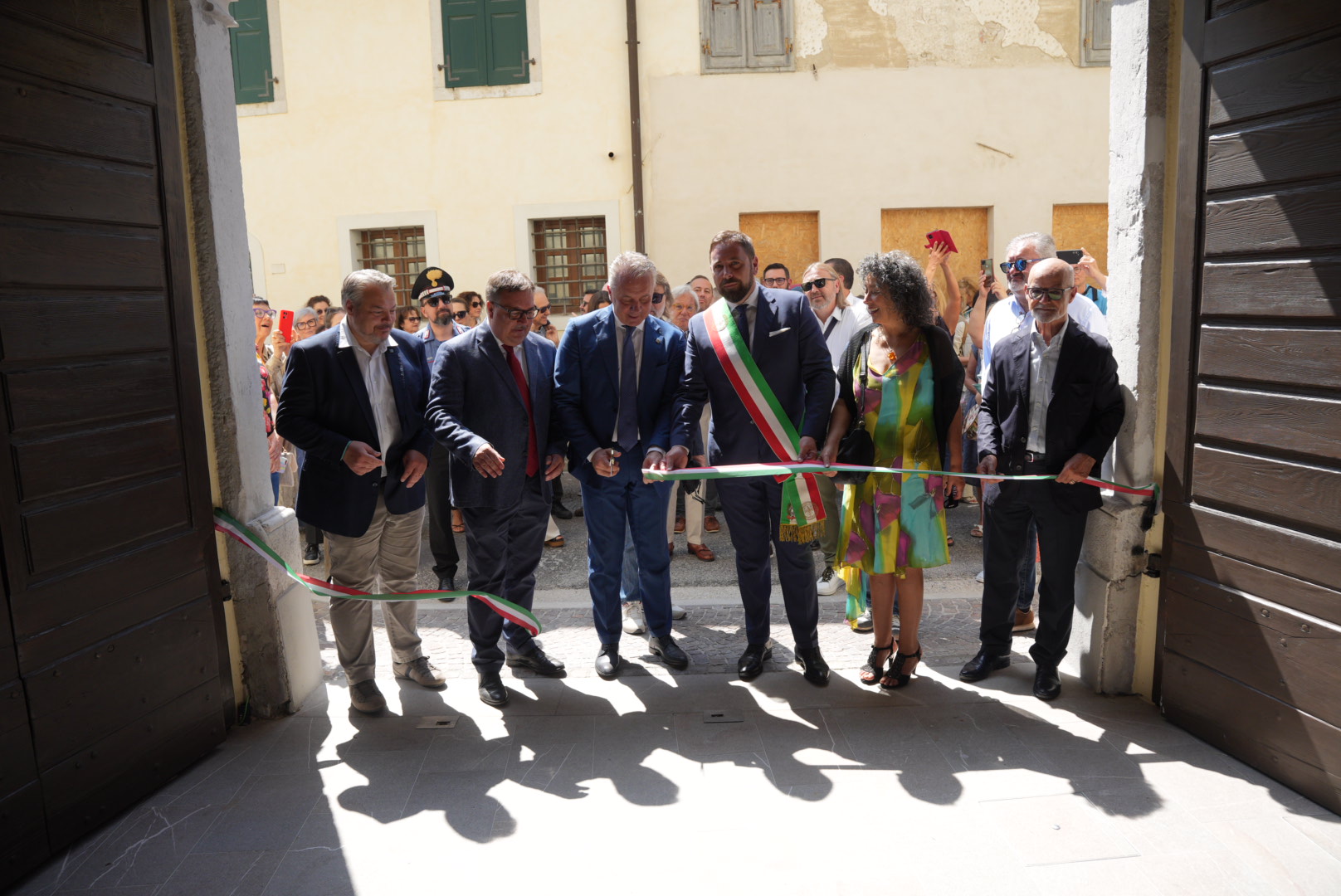
Inauguration of Palazzo Brunner-Segré | © B.Bilkic | Courtesy Fondazione Aquileia
“It was a complex project,” explains Cristiano Tiussi, director of the Aquileia Foundation, “because it involved a historic building in a very poor state of repair, which required special attention to overcome problems that arose during the work. In the initial phase, archaeological investigations were carried out, revealing the richness of the stratigraphic deposit, which remained uninterrupted from modern times to late antiquity. The work phases then proceeded smoothly. We will now continue with the restoration of the external area, which will necessarily take into account the presence of about a quarter of the amphitheatre: the aim is to uncover at least one preserved section of the foundations, to give an idea of the building's grandeur."
It was in 1812 that the Brunner complex first appeared in the Napoleonic land registry. Its construction is thought to date back to the 17th or 18th century. However, the main building was preceded by another building, dating back to the 14th-16th century, whose foundations were discovered during excavations conducted under the direction of the Superintendency in 2023, along with two “butti”, or rubbish pits, one of which was full of beautiful ceramics, glassware and everyday tableware.
It was purchased in 1923 by Gina Segré, future wife of Rodolfo Brunner. The Brunner couple soon established themselves as one of the great 19th-century families of Trieste, engaged in commercial and industrial activities ranging from shipping to insurance and oil refining. The palace was one of Gina Segré's country residences until 1947, when it was sold and, now uninhabited, passed from hand to hand until it was acquired by the State Property Office.
Beneath Palazzo Brunner-Segré lies approximately a quarter of the total area of the amphitheatre of Aquileia, preserved only at foundation level: the upper structure was dismantled over the centuries to obtain building material. The imposing foundation structures and wide drainage channels remain, sufficient to reconstruct the grandeur of the monument. Next to the building, around 300 AD, new city walls were built, a section of which was excavated in 2018-2020 by the Superintendency.
Following a conservative restoration project, Palazzo Brunner-Segré, acquired in 1996 by the State Property Office (Ministry of Culture) and transferred to the Aquileia Foundation in 2019, was inaugurated during European Archaeology Days.
The historic building in Via Roma will be the new headquarters and offices of the Fondazione Aquileia. The second floor will house a conference room, while a second phase of the project will involve the enhancement of the outdoor area, which encompasses a portion of the ancient Roman amphitheatre, and the creation of a visitor route connecting the building to Via XXIV Maggio.
“The restoration of Palazzo Brunner-Segré,” comments Roberto Corciulo, president of the Aquileia Foundation, “is particularly significant because it is a valuable historic building that has been returned to the admiration of visitors. The restoration of the historic centre’s architectural heritage, which consists of remarkable examples of spontaneous architecture, and its use to serve our guests is one of the objectives of the Foundation, which in recent years has acquired several private properties in the basilica area that were no longer inhabited. The total cost of the work, amounting to €3,068,000, was financed to the tune of €3 million thanks to the Development and Cohesion Funds of the Ministry of Culture, which, thanks to the prompt interest of the Culture Department of the Friuli Venezia Giulia Region, we were able to divert towards the restoration of Palazzo Brunner-Segré'.
It took two years of work to complete the urban regeneration of the building, located along one of the main medieval roads, the district of Sant'Andrea or dei Calzolai.
Inauguration of Palazzo Brunner-Segré | © B.Bilkic | Courtesy Fondazione Aquileia
“It was a complex project,” explains Cristiano Tiussi, director of the Aquileia Foundation, “because it involved a historic building in a very poor state of repair, which required special attention to overcome problems that arose during the work. In the initial phase, archaeological investigations were carried out, revealing the richness of the stratigraphic deposit, which remained uninterrupted from modern times to late antiquity. The work phases then proceeded smoothly. We will now continue with the restoration of the external area, which will necessarily take into account the presence of about a quarter of the amphitheatre: the aim is to uncover at least one preserved section of the foundations, to give an idea of the building's grandeur."
It was in 1812 that the Brunner complex first appeared in the Napoleonic land registry. Its construction is thought to date back to the 17th or 18th century. However, the main building was preceded by another building, dating back to the 14th-16th century, whose foundations were discovered during excavations conducted under the direction of the Superintendency in 2023, along with two “butti”, or rubbish pits, one of which was full of beautiful ceramics, glassware and everyday tableware.
It was purchased in 1923 by Gina Segré, future wife of Rodolfo Brunner. The Brunner couple soon established themselves as one of the great 19th-century families of Trieste, engaged in commercial and industrial activities ranging from shipping to insurance and oil refining. The palace was one of Gina Segré's country residences until 1947, when it was sold and, now uninhabited, passed from hand to hand until it was acquired by the State Property Office.
Beneath Palazzo Brunner-Segré lies approximately a quarter of the total area of the amphitheatre of Aquileia, preserved only at foundation level: the upper structure was dismantled over the centuries to obtain building material. The imposing foundation structures and wide drainage channels remain, sufficient to reconstruct the grandeur of the monument. Next to the building, around 300 AD, new city walls were built, a section of which was excavated in 2018-2020 by the Superintendency.
Spotlight
See allAttila, the destroyer? Maybe. In Aquileia, history retraces its steps
A thousand legends surround the Huns and the infamous Sack of Aquileia, which according to tradition would have razed the flourishing border city to the ground. But the latest discoveries tell another story.Aquileia, site of memory
The Heroes' Cemetery, historic testimony of the First World War, preserves the memory of when Aquileia was crossed by the tragic conflict that ended in 1918. In the days that followed the Great War Aquileia became a symbol of Italian spirit with the first military cemetery for the fallen on the karst front.News
See all
Udine | Seven centuries. Three fragments. One European story.
The Gospel of Mark: Three Fragments That Shaped Europe
In Aquileia, after seven centuries, the three fragments of one of the most contested manuscripts of the Middle Ages are reunited. Behind their story lies another story, older and vaster: that of a schism, of a Byzantine empire, of the Lombards, of a distant papacy, and of Slavic peoples in search of a God of their own, all summoned, across the centuries, around a single name: Mark.
Udine | Assyrian documentary wins Aquileia Film Festival
The Assyrian Empire Wins the Aquileia Film Festival
Luis Miranda's documentary wins the 17th Aquileia Film Festival, showcasing the archaeological missions rewriting the history of the ancient Assyrian Empire.
Udine | From 12 September 2026 in Aquileia
In Aquileia, for the first time in seven centuries, the three fragments of the Gospel of Mark
Venerated for centuries as the Evangelist's own autograph and divided for seven hundred years, the Gospel of Mark will be exhibited in Aquileia, where its story began: a European tale spanning Prague, Cividale and Venice.Video Itineraries
See allRoman Aquileia: public buildings
Discovering the places where public life took place in Roman times. The Forum, the beating heart...UN PROGETTO DI

IN COLLABORAZIONE CON