AQUILEIA
PATRIMONIO DELL'UMANITÀ
lunedì 5 ottobre 2026
Join the concert on June 21 at the River Port
In Aquileia, a sunrise concert celebrates the summer solstice
The River Port, archeological area of Aquileia | Photo: © Gianluca Baronchelli
Francesca Grego - 26/05/2025
For the Romans, the summer solstice was an essential celebration. It was a time to honor ancient deities such as Summanus, the mysterious Etruscan-origin sun god; Janus, the two-faced god; and Cardea, goddess of thresholds and health. Cardea, in particular, was closely tied to the solstice in a double sense: on one hand, the longest day of the year marked the hinge of the calendar, the peak of a seasonal cycle coming to an end to make way for the new; on the other, it was believed that at this specific astronomical moment, a passage opened between the living and the dead, between the divine and the human.
The ancient Roman colony of Aquileia, now a UNESCO World Heritage Site, returns to celebrate the summer solstice, reclaiming its original meaning as a threshold, in a unique setting: the River Port. For centuries, this was the city's main gateway, a meeting point between East and West, a hub for people and goods from across the Mediterranean. On the occasion of the Festa della Musica, a sunrise concert on June 21 will greet the rising sun with the music of the all-female ensemble Violoncelli Itineranti.
From Trieste, musicians Andrejka Možina, Irene Ferro-Casagrande, and Carla Scandura have composed music for poems written by Slovene women poets active in Italy (Marina Cernetig, Marija Kostnapfel, Andrejka Možina, Silvana Paletti, Zora Tavčar, Alenka Rebula Tuta, Andreina Trusgnach Cekova, Irena Žerjal). This gave birth to the ten tracks of the project Besede ne ubogajo več / Unruly Words, both an album and a bilingual book that lend their name to the Aquileia concert. It is an embrace between music and poetry, Italian and Slovene, in the year of GO! 2025, which unites Gorizia and Nova Gorica as the first cross-border European Capital of Culture.
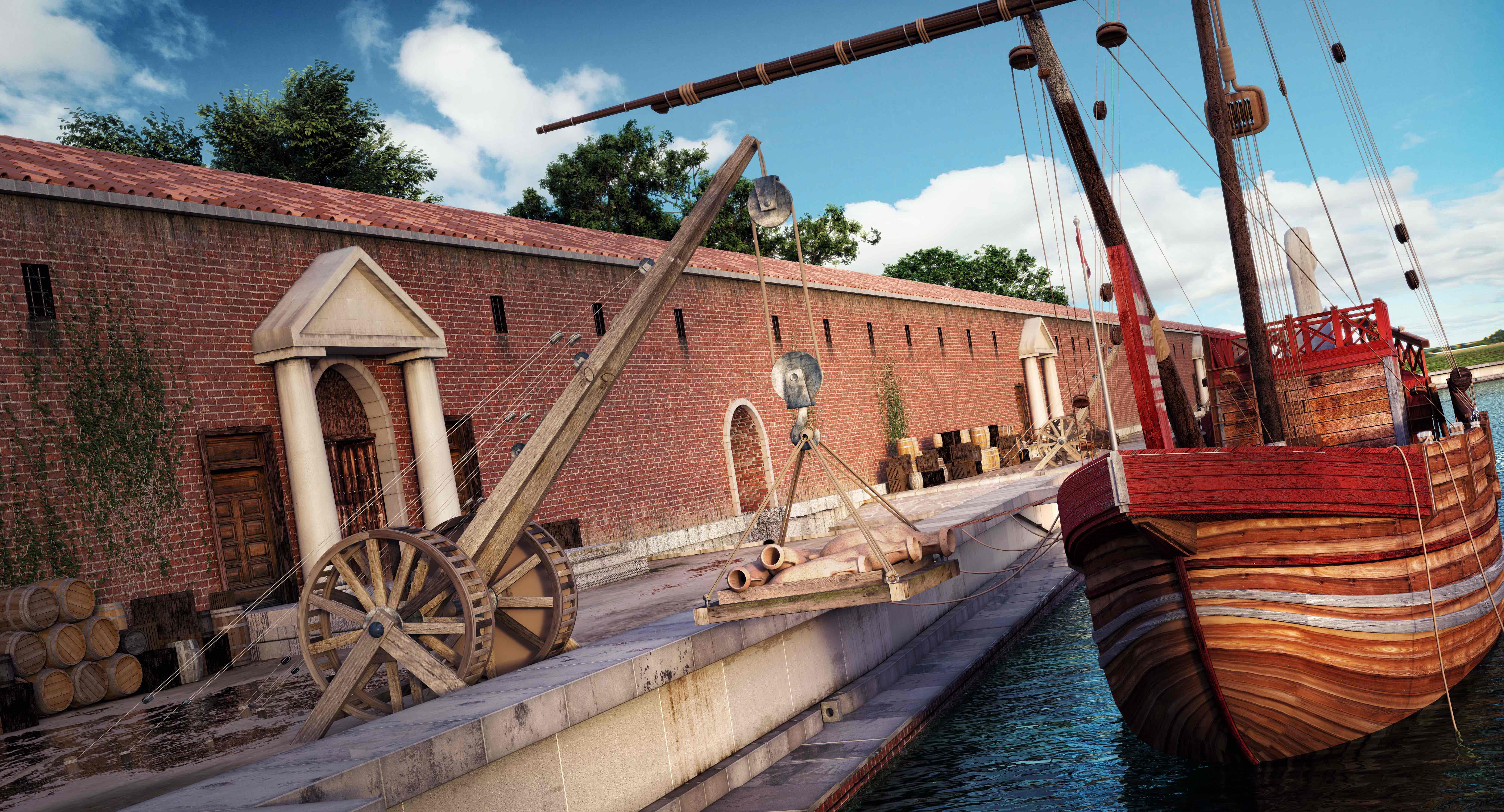
3D reconstruction of the River Port of Aquileia 2000 years ago | Courtesy of Fondazione Aquileia
At the River Port, the quays now overgrown with green grass speak to us of ancient departures and arrivals, of vanished boats and precious cargo, of sailors who, between journeys, carved simple game boards into these stones—back when Aquileia was the northernmost port of the entire Mediterranean. It was a strategic commercial hub connecting the Italian peninsula, the East, and continental Europe. The echoes of that past still resonate in the artifacts preserved in the Archaeological Museum: from amphorae used to transport food to precious amber objects—Baltic gold—that arrived here via northern trade routes.
At dawn on the summer solstice of 2025, a new story will resound among the time-worn limestone slabs, uniting past and present, East and West, on the threshold between night and day. It will unfold in a shared space—both geographical and linguistic—that once served as a gateway and a frontier. A contemporary musical narrative “to be listened to like a film,” as cellist and composer Andrejka Možina told the Trieste newspaper Il Piccolo, where “the common thread is the dream—be it dreams of love, of a vanished past, of borders falling, of freedom, of life, of energy—always told through a feminine lens.”

Aquileia, Ancient River Port. Photo by N. Oleotto | Courtesy of Fondazione Aquileia
The ancient Roman colony of Aquileia, now a UNESCO World Heritage Site, returns to celebrate the summer solstice, reclaiming its original meaning as a threshold, in a unique setting: the River Port. For centuries, this was the city's main gateway, a meeting point between East and West, a hub for people and goods from across the Mediterranean. On the occasion of the Festa della Musica, a sunrise concert on June 21 will greet the rising sun with the music of the all-female ensemble Violoncelli Itineranti.
From Trieste, musicians Andrejka Možina, Irene Ferro-Casagrande, and Carla Scandura have composed music for poems written by Slovene women poets active in Italy (Marina Cernetig, Marija Kostnapfel, Andrejka Možina, Silvana Paletti, Zora Tavčar, Alenka Rebula Tuta, Andreina Trusgnach Cekova, Irena Žerjal). This gave birth to the ten tracks of the project Besede ne ubogajo več / Unruly Words, both an album and a bilingual book that lend their name to the Aquileia concert. It is an embrace between music and poetry, Italian and Slovene, in the year of GO! 2025, which unites Gorizia and Nova Gorica as the first cross-border European Capital of Culture.
3D reconstruction of the River Port of Aquileia 2000 years ago | Courtesy of Fondazione Aquileia
At the River Port, the quays now overgrown with green grass speak to us of ancient departures and arrivals, of vanished boats and precious cargo, of sailors who, between journeys, carved simple game boards into these stones—back when Aquileia was the northernmost port of the entire Mediterranean. It was a strategic commercial hub connecting the Italian peninsula, the East, and continental Europe. The echoes of that past still resonate in the artifacts preserved in the Archaeological Museum: from amphorae used to transport food to precious amber objects—Baltic gold—that arrived here via northern trade routes.
At dawn on the summer solstice of 2025, a new story will resound among the time-worn limestone slabs, uniting past and present, East and West, on the threshold between night and day. It will unfold in a shared space—both geographical and linguistic—that once served as a gateway and a frontier. A contemporary musical narrative “to be listened to like a film,” as cellist and composer Andrejka Možina told the Trieste newspaper Il Piccolo, where “the common thread is the dream—be it dreams of love, of a vanished past, of borders falling, of freedom, of life, of energy—always told through a feminine lens.”
Aquileia, Ancient River Port. Photo by N. Oleotto | Courtesy of Fondazione Aquileia
Spotlight
See allThe Gospel of Mark: Three Fragments That Shaped Europe
In Aquileia, after seven centuries, the three fragments of one of the most contested manuscripts of the Middle Ages are reunited. Behind their story lies another story, older and vaster: that of a schism, of a Byzantine empire, of the Lombards, of a distant papacy, and of Slavic peoples in search of a God of their own, all summoned, across the centuries, around a single name: Mark.Aquileia Film Festival 2026: Telling the invisible
Aquileia will once again host its festival dedicated to archaeology, history and cultural heritage through cinema, featuring documentaries, premieres and conversations with leading scholars and researchers. The 2026 edition, themed "Telling the Invisible," explores hidden histories, collective memory and the challenges of contemporary archaeology.News
See all
Udine | Seven centuries. Three fragments. One European story.
The Gospel of Mark: Three Fragments That Shaped Europe
In Aquileia, after seven centuries, the three fragments of one of the most contested manuscripts of the Middle Ages are reunited. Behind their story lies another story, older and vaster: that of a schism, of a Byzantine empire, of the Lombards, of a distant papacy, and of Slavic peoples in search of a God of their own, all summoned, across the centuries, around a single name: Mark.
Udine | Assyrian documentary wins Aquileia Film Festival
The Assyrian Empire Wins the Aquileia Film Festival
Luis Miranda's documentary wins the 17th Aquileia Film Festival, showcasing the archaeological missions rewriting the history of the ancient Assyrian Empire.
Udine | From 12 September 2026 in Aquileia
In Aquileia, for the first time in seven centuries, the three fragments of the Gospel of Mark
Venerated for centuries as the Evangelist's own autograph and divided for seven hundred years, the Gospel of Mark will be exhibited in Aquileia, where its story began: a European tale spanning Prague, Cividale and Venice.Video Itineraries
See allRoman Aquileia: public buildings
Discovering the places where public life took place in Roman times. The Forum, the beating heart...UN PROGETTO DI

IN COLLABORAZIONE CON